Flash not Installed
 

Monitoring. A Humorous Poem by Jacob Robinson.

The year is a circle with no start and no end,
Dodecahedron rolls nine and September we shall begin.
Riparian plantings and oak woodlands stress out,
Aggravated wasps and poison oak won’t make me lose count.

Elderberries and associates surrounded by sheep fences,
Sub-plot sampling beats a full census.
Giant garter snake marshes are filled to the brim,
Now migrating waterfowl have somewhere to swim.

Marsh vegetation has grown and is ready to peak,
Record Relevé cover to round out the week.
The data for the year has all been collected,
Now hours of Excel that’s been grossly neglected.

Monitoring reports are close to be due,
Still waiting on the bosses final review.
Reports out the door without too much pain,
December is here and we’re waiting for rain.

Showers come down at all different stages,
The short straw spends Christmas checking staff gauges.
Vernal pools fill up and cold temperatures will set,
Time to dust off that invertebrate net.

Bent over all day and soaked through your clothes,
You don’t notice the smell cause you can’t feel your nose.
Dancing in the net is a familiar little guy,
Branchinectalynchi.

Take a break from the pools to go out on the prowl,
Look for a breeding pair of burrowing owl.
The weather turns warm and water goes away,
Leaving a beautiful floristic display.

On hands and knees with your face to the ground,
Making sure every last species is recorded and found.
Exit hole surveys get you up on your feet,
Finding an elderberry beetle is ever so sweet.

The pools are drying up way too fast,
We don’t know how much longer the vegetation will last.
Vernal pools are all done we dust off our hands,
What about the seasonal wetlands.

Alas veg monitoring is wrapped up ever so soon,
Spring where did you go it’s the first week of June.
Swainson’s hawk and kit fox are up for round two,
Giant garter snake traps need to be moved.

Driving back and forth and all over town,
Don’t forget those beaver dams that need torn down.
The days get longer and hotter and hotter,
It’s all we can do to keep up with the water.

Waiting on Liberty for the perfect tide,
Nothing says fun like a delta boat ride.
Let’s go down the list and see what’s next to do,
Riparian plantings and oak woodlands, this can’t be true.

I looked at the calendar like a crystal ball,
I couldn’t believe it; we’re on the door steps of fall.

- By Jacob Robinson

Rogue Valley Mitigation and Conservation Bank Approved

Wildlands is pleased to announce the final approval of the Rogue Valley Vernal Pool Mitigation and Conservation Bank, located in Jackson County, Oregon.  The project has been approved through an agreement with U.S. Fish and Wildlife Service, U.S. Army Corps of Engineers, and Oregon Department of State Lands, and in coordination with U.S. Environmental Protection Agency, Oregon Department of Fish and Wildlife, Oregon Department of Environmental Quality and Rogue Valley Council of Governments to mitigate permitted impacts to vernal pools, wetlands, vernal pool fairy shrimp, and large-flowered woolly meadowfoam.  Mitigation credits developed at the Rogue Valley Bank allow public and private developers in the Agate Desert vernal pool region, which includes portions of Jackson, Douglas, Josephine, and Klamath counties, to responsibly meet their mitigation requirements.

The 131-acre project represents one of the highest priority private lands identified for conservation in the Rogue Valley.  The project will focus on the conservation and management of federally listed threatened and endangered species and their associated wetland habitat.  The property is permanently protected with a conservation easement held by the Southern Oregon Land Conservancy and a non-wasting endowment has been established to ensure management of the property in perpetuity.

The Bank property supports a large, intact expanse of vernal pools and swales with known occurrences of the federally threatened vernal pool fairy shrimp and the federally endangered large-flowered woolly meadowfoam. The Bank is located within designated critical habitat for vernal pool fairy shrimp.

Bank credits generated at the Rogue Valley Bank can be purchased by public agencies and by private developers who need to fulfill mitigation for permitted impacts authorized by the U.S. Fish and Wildlife Service, Oregon Department of State Lands, and U.S. Army Corps of Engineers.  Purchasing credits typically streamlines the process for projects needing to provide mitigation.

“Generally development impacts to vernal pool habitat are small and fragmented.  By purchasing credits at the Bank, both public and private development projects can contribute to a larger, higher functioning vernal pool complex that will be managed in perpetuity, thereby fulfilling the developer’s mitigation needs while simultaneously helping the agencies meet their mitigation, conservation, and recovery goals.” Said Julie Mentzer, Director of Environmental Operations for the Pacific Northwest division of Wildlands based in Portland.

This is Wildlands’ first approved bank in Oregon.  The company manages over 45 such projects in California and Washington.  “We are so excited to have our first bank approved in Oregon. Wildlands is proud to provide a needed mitigation and conservation alternative in an area most agree is critically important to the continued existence of vernal pool species in the Rogue Valley,” said Mentzer.

Additional projects are in the works in Oregon.  “We see a lot of opportunity for our company in Oregon, and we hope this is just the first of many new projects as several others are already in planning,” added Mentzer.

Wildlands Mitigation & Ecosystem Conference Recap

Wildlands played a significant role at the recent 2012 National Mitigation & Ecosystem Banking Conference in recent weeks, giving us the opportunity to interact with attendees and demonstrate our extensive capabilities in the areas of mitigation banking and ecosystem development.

After assembling our booth, we co-hosted the welcoming reception for all attendees. Below, you can see that Kathy, Larry, Sherrie and Brian are ready to greet the masses!

We also presented and moderated in several sessions regarding mitigation banking and ecosystem banking, including Conservation and Fish Banking, Emerging Markets and Trends in Banking.

To give a hands-on experience to attendees, Wildlands offered tours of our nearby properties, including the Gilsizer Slough Giant Garter Snake Mitigation Complex and the Liberty Island Conversation Bank.

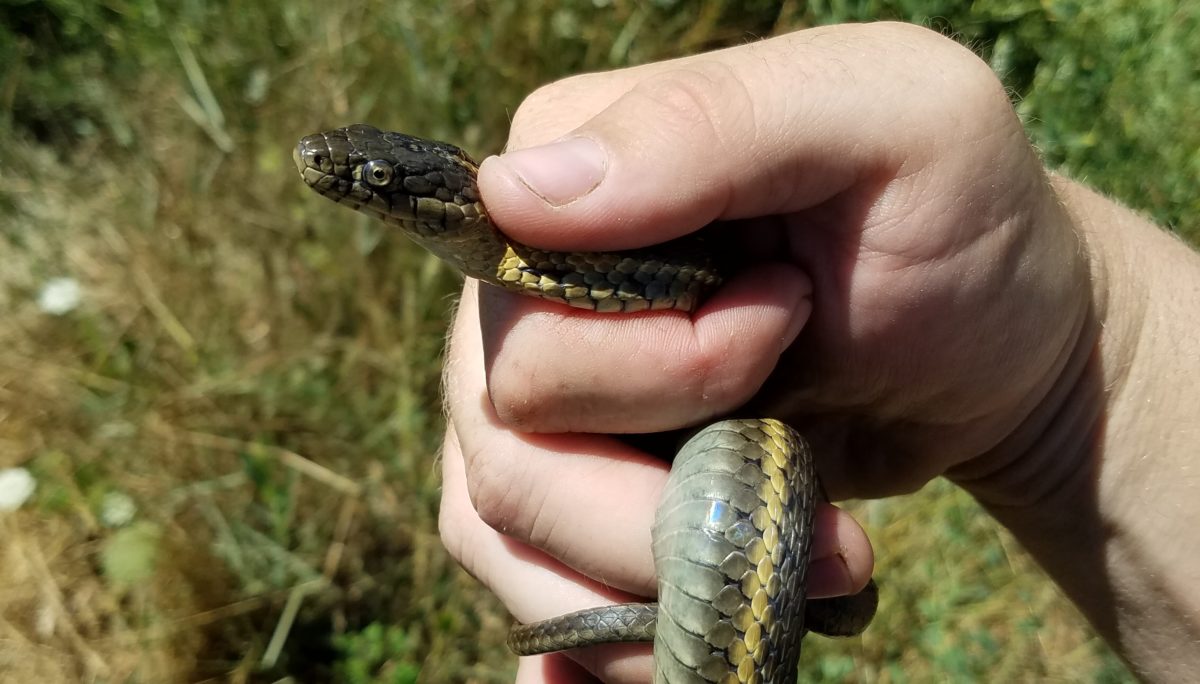
Wildlands’ Gilsizer Slough Giant Garter Snake (GGS) Mitigation Complex is comprised of over 620 acres of created and preserved wetland and open water channel habitat dedicated to the restoration and preservation of the aquatic giant garter snake. Located in Sutter County, approximately nine miles southwest of Yuba City, conference attendees were fortunate to see a Giant Garter Snake while taking the property tour. (Yes, the “Giant” Garter Snake is this actually this small.)

We also showcased our salmon, delta smelt and longfin smelt conservation bank, the Liberty Island Conservation Bank, located in the Sacramento-San Joaquin River Delta. The project involved a major tidal and flow-through channel restoration effort on the 186-acre site. Visiting this site involves a quick boat ride, but the payoff is clear once you arrive onsite.

The Bank is a collaborative effort between Wildlands, California Department of Fish and Game (DFG), National Marine Fisheries Service (NMFS) and U.S. Fish and Wildlife Service (FWS) and is utilized to mitigate permitted impacts to fisheries habitat throughout the Sacramento-San Joaquin River Delta.

In this photo, Wildlands’ Project Director Brian Monaghan presents aerial photos so attendees can see before and after photos that demonstrate the positive environmental impact of this restoration project.

Many thanks to the organizers of the National Mitigation Banking & Ecosystem Banking Conference for putting together a great conference.

Wildlands Sponsors National Mitigation Banking & Ecosystem Banking Conference

Wildlands is excited about the 2012 National Mitigation & Ecosystem Banking Conference taking place in May in Sacramento, right here in our backyard. We are strongly supporting this event by sponsoring the mitigation banking conference, co-hosting the welcoming reception, participating in several presentations, and offering tours of nearby Wildlands properties.

First, Wildlands will be co-hosting the Welcoming Reception on opening night with JT&A, Inc. and Timbervest, LLC (Wednesday 5:30 pm – 7:00 pm in the Exhibit Area).

Wildlands is taking an active presenting role at the Mitigation Banking & Ecosystem Banking Conference, including sessions on Conservation and Fish Banking, Emerging Markets, and Trends in Mitigation Banking presented or moderated by experts from our staff. Here are details on Wildlands’ NMBA conference presentations.

Wednesday, May 9
Session 2: Conservation and Fish Banking
Julie Mentzer will be presenting on the Liberty Island Conservation Bank for Salmon, Delta Smelt and Longfin Smelt, one of three topics under the Conservation and Fish Banking session. (Co-author: Carl Jensen, ICF Jones & Stokes International)

Thursday, May 10
10:00 am – 11:30 am
Session 5: Emerging Markets
Wayne White will be the Moderator for this session focusing on Emerging Markets (3 Topics: The Ohio River Basin Water Quality Trading Project; New Environmental Mitigation Policy in British Columbia, Canada; and Effectiveness of Biodiversity Banking from Perspective of Japan)

11:30 am – 1:45 pm
Luncheon Plenary Session: Trends in Banking
Steve Morgan will be the Moderator for this Luncheon Plenary on banking trends (3 Topics: ILF Programs Nationally & the Movement to Utilize ILF Funds to Purchase Mitigation Banking Credits; Louisiana Restoration and Contracting; and Mitigation Banking Industry: Growing Shrinking or Consolidating?)

Wildlands’ Director of Business Development, Wayne White, is a National Mitigation Banking Association board member and has been assisting the conference steering committee in developing the agenda and preparing for two of five field trips planned as part of the conference. We looking forward to showcasing our salmon, delta smelt and longfin smelt conservation bank, the Liberty Island Conservation Bank, located in the Sacramento-San Joaquin River Delta. The project involved a major tidal and flow-through channel restoration effort on the 186-acre site. The Bank is a collaborative effort between Wildlands, California Department of Fish and Game (DFG), National Marine Fisheries Service (NMFS) and U.S. Fish and Wildlife Service (FWS) and is utilized to mitigate permitted impacts to fisheries habitat throughout the Sacramento-San Joaquin River Delta.

Wildlands’ Gilsizer Slough Giant Garter Snake (GGS) Mitigation Complex will be featured on a separate tour. The Complex is comprised of over 620 acres of created and preserved wetland and open water channel habitat dedicated to the restoration and preservation of the aquatic giant garter snake. Located in Sutter County, approximately nine miles southwest of Yuba City, the Complex has been utilized by both public works agencies and private developers as a GGS mitigation solution to fulfill permit obligations.

“Wildlands is pleased to be able to continue to sponsor the National Mitigation Banking Conference as we have for the past 12 plus years,” said Steve Morgan, Wildlands CEO. “The assemblage of mitigation bankers, state and federal regulators and affiliated parties has proven to be a valuable vehicle to refine, strengthen, and grow our unique industry. As always we feel very great full to be apart of the mitigation banking industry as well as the Mitigation Banking Association.”

For more information on the National Mitigation & Ecosystem Banking Conference, please visit their website.

Wildlands Signs on as Powerhouse Science Center Founding Partner

The Powerhouse Science Center in Sacramento recently announced that Wildlands has joined the campaign to build the premier science learning center serving Northern California.

As a founding partner, Wildlands joins other regional leaders and organizations in a cooperative effort to support the development of this vital new community asset.
Located on the scenic banks of the Sacramento River, the Powerhouse Science Center will function as a model for 21st-century experiential STEM education (science, math, technology, engineering, space) and environmental stewardship. The design will be an exemplary “green” building that serves as an environmental teaching lab.

“Wildlands has been protecting environmental resources in the Sacramento region for over twenty years and, we are so pleased to partner with the Powerhouse Science Center to continue raising awareness of the importance of science, math and engineering. These are all disciplines we employ everyday at Wildlands. The Powerhouse Science Center can help be a breeding ground for future conservationists, scientists and engineers who can contribute to the overall environmental health and well-being of our region,” said Brian Monaghan, Project Director for Wildlands.

Wildlands joins the regional effort to create a home for a high-tech, hands-on science museum for the Greater Sacramento region that will immerse children in science, technology, engineering, and math. The Powerhouse Science Center will play a key role in inspiring young people to become the future engineers and scientists that California and our nation desperately need.

“We are extremely pleased to welcome aboard Wildlands as one of our founding partners,” said Michele Wong, Interim Executive Director for the Powerhouse Science Center. “Wildlands brings unique environmental expertise necessary to our goal of transforming a historic Sacramento landmark into a cutting edge educational center, featuring a museum, planetarium, restaurant, and conference center. The Powerhouse Science Center is a tremendous collaborative effort between many dedicated groups and individuals that are all playing a significant role in making this vision of a premier science education center become a reality.”

Supporters of the Powerhouse Science Center include business and civic leaders, clubs and organizations, individuals, and the City of Sacramento. Sacramento Mayor Kevin Johnson recognizes this project as a top priority for Sacramento’s future.

The facility will serve as a public forum, showcasing the latest scientific discoveries in a venue accessible to the entire family. The Center will highlight the scientific achievements of the Sacramento region, the latest developments in medical science and technology, and the fundamentals of resource conservation. It will also be a field trip destination for pre-kindergarten to 12th grade students from throughout the region.

The Center, which will cost an estimated $50 million, has nearly completed its pre-construction phase. The 61-year old Discovery Museum Science & Space Center on Auburn Boulevard is scheduled to move from its current location and become the Powerhouse Science Center in 2014.

For more information on the Powerhouse Science Center, including how to become a Founding Partner, visit www.powerhousesciencecenter.org.

Delta Smelt: Social Outcast.

A Humorous Editorial by Jacob Robinson

Schoolyard bullying has been around since the dawn of schoolyards, and possibly before that. The effects of bullying on both the bully and the bullied are widely debated, and conclusions about the matter are widely diverse. Is bullying a necessary evil that helps shape our youth into well rounded, well-adjusted members of society that are ready to handle what the world throws at them? Or is it a cry for help that goes unheard upon the unwashed masses, leaving social pain and sadness in its wake? For the delta smelt, bullying has turned this happy Osmeridae into the wallflower of the delta.

A recent epidemic has occurred throughout the upper San Francisco estuary, schools of Chinook salmon have been tormenting delta smelt. These salmon, which are typically adults migrating up to spawn or smolts heading out to sea, have been making a previously unscheduled stop on their journey. It is unknown how the feud originally started; some speculate that an elder smelt and a juvenile salmon were fighting over the same piece of detritus, and things escalated quickly from there. Regardless of its origin it has gotten way out of hand and needs to be stopped.

Although the adult Chinooks constantly remind the smelt of how badly they swim and how they will never get to travel to the exotic coastal destinations, the smolts are by far the worst. At first they started out by making fun of the smelts name Hypomesus transpacificus, stating how they are super messy and pointing out the obvious of how the smelt will never make a transpacific journey. Soon they pointed out the smelt’s smell which sources say is like “Putrid Cucumbers,” coining the phrase, “you smelt it you dealt it,” a clever play on “delta smelt.” Another common phrase uttered by smolts is, “O instead of E gets you out to sea.” Just plain rotten!

I don’t know what the future holds for the relationship between the delta smelt and Chinook salmon. I like to believe their problems can be worked on and ultimately be worked out. Fortunately for the delta smelt and Chinook salmon there are safe places like Wildlands’ Liberty Island Conservation Bank, where these species can coexist and discuss their differences. I think with a little bit of time and a little hard work they will learn that there is enough detritus in the delta for everyone.

California Tiger Salamander Discovered at Mitigation Bank

Wildlands is excited to report the discovery of an adult California tiger salamander (Ambystoma californiense) (CTS) in one of the created vernal pools on the 627-acre North Suisun Mitigation Bank located in Solano County, California. The Bank was established to provide compensatory mitigation for impacts to wetlands and threatened or endangered species, including CTS, vernal pool fairy shrimp (Branchinecta lynchi) and vernal pool tadpole shrimp (Lepidurus packardi) through habitat preservation, creation, and restoration activities.

Surveys conducted over the last 5 years have revealed the presence of listed vernal pool invertebrates in over 20% of the created pools, far exceeding the Bank’s performance standard requirement. Only in its 6th year of operation, the North Suisun Mitigation Bank has attained all “Year 10” performance standards, demonstrating the ecological success of the Bank.

Wildlands Supports ‘Calling Back the Salmon’ Community Event

Wildlands is proud to have been a participating sponsor in the recent 2nd Annual Calling Back the Salmon Celebration put on by Wildlife Heritage Foundation (WHF) and Save Auburn Ravine Salmon and Steelhead (SARSAS). The all-day event was held at McBean Park in Lincoln, California with the purpose of uniting the community to educate and promote a return of the salmon run to the Auburn Ravine. Events of the day included live music, art and craft activities for the kids, a silent auction and raffle.

Founded in 2000, WHF is a local non-profit corporation that provides land conservation services and is dedicated to preserving California’s open spaces, agricultural land, and diverse wildlife. SARSAS was formed with the mission “to return salmon and steelhead to the entire length of the Auburn Ravine.”

For more information about either organization click here: WHF or SARSAS.

WILDLANDS’ REGIONAL MANAGER ELECTED PRESIDENT OF LOCAL WILDLIFE SOCIETY

Richard “Skip” Moss, Wildlands’ Regional Manager for the Central California Region, has been elected President of the San Joaquin Valley Chapter of The Wildlife Society.

After years of dedicated participation and active enjoyment, Skip was excited to hear that he had beaten the competition for the coveted three-year position. According to the Chapter Charter, his first year will be spent as the “President Elect,” followed by one year as “Active President,” and his final year of service as “Past President.”

Over the course of his tenure, Skip hopes to facilitate an increase in membership through more efficient marketing, more successful and poignant training and workshops, and more enjoyable professional development and volunteer opportunities. If you have any ideas or opportunities for Skip and the San Joaquin Valley Chapter, please contact him at rmoss@wildlandsinc.com.

Congratulations Skip, and good luck on helping your Chapter grow, develop, and improve under your leadership.

WILDLANDS COMPLETES FISH HABITAT RESTORATION AT LIBERTY ISLAND

Wildlands, Inc. announces the completion of habitat restoration at the Liberty Island Conservation Bank in Yolo County, California. The completion of construction caps a three year entitlement and permitting process with federal, state and local agencies in one of the most complex restoration projects in Wildlands 20-year history.

The 186-acre restoration project focused on tidal aquatic habitat suitable for special-status fish species. The Liberty Island Conservation Bank is a collaborative effort between Wildlands, California Department of Fish and Game (DFG), National Marine Fisheries Service (NMFS) and U.S. Fish and Wildlife Service (FWS) and will mitigate permitted impacts to fisheries habitat throughout the Sacramento-San Joaquin River Delta. The Bank is protected with a permanent conservation easement and a non-wasting long-term endowment to manage the property in perpetuity.

Watch the Liberty Island Restoration Project video case study:

The development of the project comes at a crucial time when varied environmental and water interests throughout California debate the current health and long term future of the Delta. All parties can agree that projects like Liberty Island are critical to the sustainability of the Delta as both an ecosystem and an economic engine for the State.

“There is a lot of attention being focused on habitat restoration in the Delta. Wildlands is proud to actually be implementing a needed restoration project in an area most agree is critically important to the continued survival of listed fish species like salmon, longfin smelt and Delta smelt,” said Steve Morgan, Wildlands CEO. “The approval and construction of this project is a true credit to all the talented and varied disciplines at Wildlands. Our planning, biology and design/build groups have put forth a remarkable effort to get this critically important project built.”

Restoration at Liberty Island called for developing a mosaic of habitats beneficial to Delta native fish species. The construction included creating open water channels, tidal emergent marsh, seasonally inundated floodplain habitats and removing levees which impeded tidal and flood flow. In all over 190,000 cubic yards of material was moved to complete the project.

The project was a complex permitting and construction effort that involved input from a multitude of agencies and consultants.  “The design was a collaborative effort. The resource agencies, particularly NMFS, FWS and DFG, provided significant input in developing the restoration design and overall management of the project. Agency input and expertise is critical for all of our projects,” said Carl Jensen, Wildlands Director of Design Build.

Earthmoving was done by Chris Galloway Construction of Davis, California, who has developed a significant track record of habitat restoration projects working with Wildlands.

“One of the main challenges was just getting equipment on to the island,” said Chris Galloway, owner of Chris Galloway Construction. “Since access to the island is limited, we had to barge our heavy equipment to the project one piece at a time.”

“Earthwork on habitat restoration projects can be especially challenging because you are working in close proximity to water and getting the proper grading elevation is crucial to the success of the project,” continued Jensen. “Chris Galloway uses state of the art GPS-enabled equipment to ensure exact grades down to the inch.”

Additional Delta restoration projects are planned by Wildlands in 2011 and 2012. “We predict sizable need for a company like Wildlands to implement restoration projects throughout the Delta and we have developed a proven team who can act quickly and effectively,” said Morgan.